

AI and Automation: No Longer Optional for Small Industries
M.K.Hegde
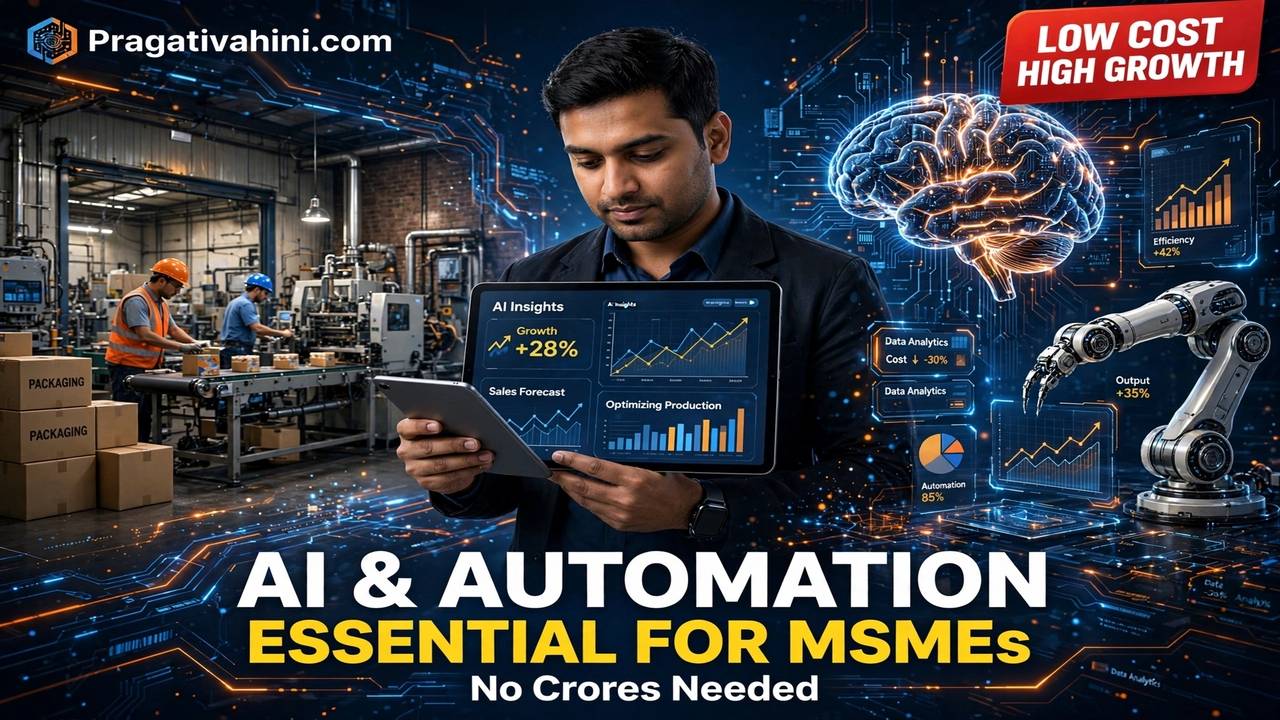
Artificial Intelligence (AI) and automation are no longer technologies reserved for large IT companies, global corporations or technology start-ups. They are rapidly becoming practical business tools for small and medium-sized enterprises (MSMEs) as well.
For a small manufacturing unit, a trading business, a service provider or a growing family-owned enterprise, AI does not necessarily mean investing crores of rupees in sophisticated technology. In many cases, it can begin with something as simple as automating repetitive office work, analysing sales data, responding to customer enquiries or predicting when a machine may require maintenance.
The real question for MSMEs is no longer whether AI will affect their business. The more important question is: How quickly can they use AI to reduce costs, improve productivity and compete more effectively?
AI Is Not Just for IT Companies
There is a common misconception that AI is relevant mainly to software companies. In reality, almost every business generates data and performs repetitive tasks—two areas where AI and automation can make a significant difference.
A manufacturing company can use AI to monitor machines. A retailer can analyse customer buying patterns. An accountant can automate invoice processing. A human resources department can screen applications. A small business can use AI tools to create marketing content, analyse customer feedback and provide basic customer support.
The technology is increasingly becoming accessible through cloud-based and subscription-based platforms. This allows MSMEs to start small, experiment and scale up gradually instead of making large upfront investments.
1. Predictive Maintenance in Manufacturing
For manufacturing companies, unexpected machine breakdowns can result in production losses, delayed deliveries and higher repair costs.
Traditional maintenance is often either reactive—repairing equipment after it breaks—or preventive, where machines are serviced according to a fixed schedule.
AI can take this a step further through predictive maintenance.
Sensors and machine data can be analysed to identify unusual vibrations, temperature changes, energy consumption patterns or other indicators of possible equipment failure. AI systems can alert management before a serious breakdown occurs.
For a small manufacturing unit, even a basic predictive-maintenance system for critical machines can help reduce downtime, improve equipment utilisation and plan maintenance more efficiently.
The objective is simple: move from “repair after failure” to “act before failure.”
2. Smarter Inventory Management
Inventory is one of the biggest areas where working capital can get locked up.
Excess inventory means money is sitting on shelves. Too little inventory can result in missed orders and unhappy customers.
AI-powered inventory systems can analyse historical sales, seasonal demand, purchasing patterns and other relevant data to help businesses estimate future requirements.
For example, a small engineering company can identify which raw materials are moving quickly and which items have remained unused for months. A retailer can analyse previous sales to anticipate demand during festivals or seasonal periods.
AI cannot eliminate uncertainty, but it can help MSMEs make inventory decisions based more on data than intuition alone.
3. Accounting Automation
Finance and accounting involve numerous repetitive activities—invoice generation, data entry, payment reminders, expense classification, reconciliation and reporting.
Many of these tasks can now be automated.
AI-enabled accounting solutions can extract information from invoices, categorise transactions, identify unusual entries and generate financial reports. Automated reminders can also help businesses follow up on outstanding payments.
For an MSME, the benefit is not merely saving an accountant’s time. Faster and more accurate financial information can help the owner understand cash flow, receivables, expenses and profitability more clearly.
Automation should support the accountant, not replace financial oversight. Human verification remains important, particularly for taxation, compliance and significant financial decisions.
4. AI-Powered Customer Service
Customers increasingly expect quick responses, even from small businesses.
An MSME may not have the resources to maintain a large customer-support team. AI-powered chatbots and automated communication tools can help answer frequently asked questions, provide product information, share order updates and collect customer enquiries.
These systems can operate beyond normal business hours and can handle multiple routine queries simultaneously.
However, businesses should ensure that customers can reach a human representative when an issue is complicated, sensitive or requires judgement.
The best approach is therefore AI for routine queries and people for relationships and complex problems.
5. Digital Marketing at Lower Cost
Digital marketing is another area where MSMEs can benefit significantly from AI.
Creating social-media posts, product descriptions, email campaigns, advertisements and promotional material traditionally requires considerable time and professional resources.
AI tools can assist businesses in generating first drafts, developing content ideas, translating material into different languages, analysing campaign performance and identifying customer segments.
A small manufacturer in Belagavi, for example, can use AI-assisted tools to prepare product descriptions, social-media content and email campaigns in English, Kannada and Marathi.
But AI-generated content should not simply be published without review. Businesses need to ensure that the information is accurate, relevant and consistent with their brand.
6. Quality Control and Defect Detection
Quality control is critical for manufacturing companies.
AI-based computer vision systems can inspect products, components, packaging and surfaces for defects. Cameras combined with image-analysis software can identify scratches, incorrect dimensions, missing components or other abnormalities.
Large factories may deploy sophisticated automated inspection systems. Smaller units can begin with more focused applications—such as checking a specific component or identifying a particular type of defect.
The business case becomes stronger when inspection is repetitive, high-volume and dependent on consistent standards.
AI can therefore help move quality control from random inspection towards continuous and data-driven inspection.
7. HR and Recruitment
Recruitment can consume significant time for a growing MSME.
AI can assist HR teams by organising applications, extracting information from resumes, matching candidates with job descriptions and scheduling interviews.
AI can also help prepare job descriptions, employee communication, training material and basic HR documentation.
However, recruitment decisions should not be delegated entirely to an algorithm.
AI systems can reproduce biases present in the data or make incorrect assumptions about candidates. Human review, transparent criteria and equal-opportunity practices remain essential.
The right use of AI in HR is to reduce administrative workload while keeping important people-related decisions under human supervision.
8. Sales Forecasting and Business Intelligence
One of the biggest advantages of AI is its ability to analyse large amounts of business data quickly.
An MSME can combine sales, customer, inventory and financial information to identify patterns.
Which products generate the highest margins?
Which customers are buying repeatedly?
Which products are losing demand?
Which months generate the highest sales?
Which customers have delayed payments?
AI-powered analytics can help answer such questions and present the information in a form that business owners can understand.
This can gradually transform decision-making from “I think this will sell” to “the data indicates this is likely to sell.”
How Can MSMEs Adopt AI Without Spending Too Much?
The biggest mistake would be to treat AI adoption as a race to purchase expensive technology.
MSMEs should instead start with business problems.
Start Small
Identify one repetitive or costly process.
For example:
Invoice data entry
Customer enquiry handling
Social-media content creation
Inventory reporting
Employee attendance analysis
Sales reporting
Document preparation
Automate one process, measure the result and then expand.
Use Cloud-Based Tools
Many AI applications are available on subscription models. This reduces the need for expensive servers, specialised infrastructure and large technology teams.
Businesses can pay for what they use and increase their investment as the benefits become visible.
Train Existing Employees
AI adoption does not necessarily require hiring a large team of AI specialists.
An accountant can learn AI-assisted accounting tools. A sales executive can use AI for customer analysis. An HR executive can use AI for recruitment administration. A production manager can use data analytics for machine monitoring.
The key requirement is AI literacy across the organisation.
Protect Business Data
Cost reduction should never come at the expense of data security.
MSMEs should establish clear rules about what information employees can upload to public AI tools. Sensitive customer information, financial records, passwords, intellectual property and confidential business documents should be handled carefully.
Businesses should also review the privacy and security terms of AI platforms before using them for sensitive operations.
Measure Return on Investment
Every AI project should have a measurable objective.
If an automated system saves 20 hours of administrative work every month, that is measurable.
If predictive maintenance reduces machine downtime, measure the reduction.
If digital marketing generates more qualified enquiries, track them.
If an AI chatbot reduces repetitive customer-support work, calculate the time saved.
AI should not be adopted because it is fashionable. It should be adopted because it creates measurable business value.
The Human Factor Will Remain Important
AI can analyse information, generate content and automate processes, but business relationships remain fundamentally human.
Customers still value trust. Employees need leadership. Suppliers require relationships. Negotiations require judgement. Strategic decisions involve experience and responsibility.
Therefore, the future is unlikely to be simply “AI versus humans.”
For MSMEs, the more practical model is “AI plus humans.”
Employees who learn to use AI effectively may become more productive, while businesses that successfully combine technology with human experience can potentially improve their competitiveness.
The Future: AI as a Business Infrastructure
Over the next few years, AI is likely to become increasingly embedded in ordinary business software.
Accounting systems will become more intelligent. ERP platforms will provide predictive insights. Manufacturing systems will detect problems earlier. Customer-service platforms will automate routine interactions. Marketing systems will become more personalised.
This means AI may eventually become less of a separate “technology project” and more of a normal layer within everyday business operations.
For MSMEs, the opportunity is significant.
They do not have to compete with large corporations by spending more. They can increasingly compete by using technology more intelligently, operating more efficiently and responding faster to customers.
Conclusion
AI and automation are no longer futuristic concepts. They are becoming practical tools for businesses of every size.
For small industries, the path forward does not require massive investment or a complete transformation overnight.
Start with one problem.
Automate one process.
Train one team.
Measure one result.
Then expand.
The MSME of the future will not necessarily be the company with the biggest technology budget. It may be the company that understands where technology can create the greatest value—and combines it effectively with the skills, experience and judgement of its people.
For small industries, AI is moving from an option to an important part of staying competitive.