




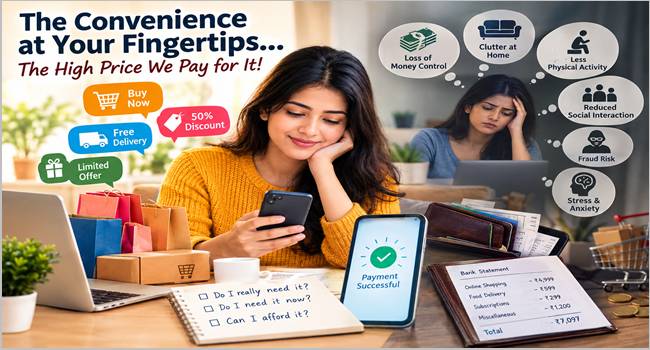
The Convenience at Your Fingertips… The High Price We Pay for It
Online Shopping and Digital Payments: What Is Excessive Use Taking Away From Our Lives?

By M.K. Hegde
This is the digital age.
Sitting at home, we can buy products from anywhere in the world. There is no need to visit a shop. No standing in queues. No counting cash. No waiting for the bill.
One click of the finger…
The product arrives at our doorstep.
Another click…
The money moves into someone else’s account.
Everything is incredibly easy. It is fast. It saves time.
But the greater the convenience, the more important it is to understand its price.
There is no doubt that online shopping and digital payments have made our lives easier. But excessive dependence on them is gradually affecting our spending discipline, physical activity, social interaction, shopping habits and even our peace of mind.
By the time we realise it, the money is gone.
By the time we realise it, our homes are filled with things we do not really need.
By the time we realise it, our expenses have increased significantly.
So, why do we need to be cautious?
1. We no longer see the value of money
If we have a ₹2,000 note in our hand, we may think twice before spending it.
We are conscious that it is money earned through hard work.
When we physically count and hand over cash at a shop, a calculation happens in our minds.
But with digital payments, we do not actually see the money leaving our hands.
A number simply decreases on the mobile screen.
That is all.
As the physical feeling of money leaving our hands disappears, the psychological barrier to spending can also become weaker.
When the pain of spending becomes less visible, the tendency to spend can increase.
2. The habit of bargaining is disappearing
When we visit a local shop, we often ask:
“Can you reduce the price a little?”
“Is there any further discount?”
“They are offering it for this price at another shop…”
Sometimes, such conversations themselves help us get a better price.
But online, we see a price and simply click ‘Buy Now’.
No bargaining.
No conversation.
Sometimes, we do not even compare the price with other sellers.
3. Unnecessary purchases increase
This is perhaps one of the biggest effects of online shopping.
To visit a physical store, we have to get ready.
We have to take a vehicle or walk.
We have to spend time.
We have to reach the shop.
We have to look at the product.
All of this gives us some time to think before making a purchase.
Online, none of this is necessary.
We remember something.
We pick up the phone.
We search.
We add it to the cart.
We place the order.
The entire process may be over within minutes.
The less time we give ourselves to think, the greater the opportunity for unnecessary purchases.
4. Spending more in the name of ‘offers’
“50% Discount”
“Limited Offer”
“Only Today”
“Buy 2 Get 1”
“Free Delivery”
Messages like these constantly push us towards purchasing.
Even when we do not need something, we may think:
“It is available at such a low price. Let us buy it.”
But we should ask ourselves one question:
“Do I really need this?”
Even if a ₹1,000 product is available at a 50% discount, the remaining ₹500 is still money spent if we do not actually need the product.
5. The culture of excessive consumption grows
Earlier, we bought something when we needed it.
Now, sometimes, we feel we need something simply because we have seen it.
That is a major difference.
Mobile phones, clothes, shoes, kitchen appliances, decorative items, electronic gadgets…
Even when we already have a particular product at home, seeing another model can create the urge to buy it.
Thus, desire gradually becomes more important than necessity in deciding what we buy.
6. Digital payments reduce the ‘pain’ of spending
When we pay in cash, we can see our money decreasing.
With digital payments, that experience is reduced.
₹200, ₹500, ₹800, ₹1,200…
Small payments can eventually become a large amount.
The expenditure on any single day may not seem significant.
But when we look at the bank statement at the end of the month, the total can come as a surprise.
Small expenses can become big expenses.
7. EMIs and ‘Buy Now, Pay Later’ add another trap
When we see the full price of a product, we may reconsider buying it.
But when the screen says,
“Only ₹999 per month,”
the purchase suddenly appears affordable.
This can encourage people to spend beyond their actual purchasing capacity.
One EMI, two EMIs, three EMIs…
Eventually, a portion of the monthly income is already committed.
8. Physical activity associated with shopping is reduced
Going to a shop, walking around, looking at products and carrying them home involve small amounts of physical activity.
With online shopping, everything can be completed while sitting on a sofa.
This may not appear to be a major problem on any single day.
But if we begin depending on our phones for every small task, our overall daily movement and physical activity can gradually decline.
9. Impact on local shops and small businesses
The shopkeeper in our neighbourhood may be someone we know.
We may know his family.
We may see the lives of the people working in that shop.
Money spent locally also circulates within the local economy.
If we develop a habit of buying everything online, it can have an impact on the business of small local traders.
We should not completely lose our local relationships in the name of convenience.
10. Social interaction and relationships can decline
When we visit a shop, we may meet someone we know.
We exchange a few words.
We hear about local happenings.
We may ask about a neighbour or a friend’s family.
A small purchase can sometimes become an opportunity for social interaction.
Online?
Order.
Payment.
Delivery.
Finished.
There is no human interaction.
11. The risk of fraud
One of the major concerns associated with digital payments is fraud.
Fake links, fake customer-care numbers, people asking for OTPs, fraudulent offers, phishing messages and fake websites require constant vigilance.
Messages such as:
“Your account will be blocked…”
“You have won a prize…”
“Click this link to receive your refund…”
may be attempts by fraudsters to steal money or personal information.
One careless click can result in a major financial loss.
12. We cannot physically examine the product
When buying clothes from a physical shop, we can see the colour.
We can check the quality.
We can touch the fabric.
We can examine the size, weight and design.
Online, we largely depend on photographs and descriptions.
A product that looks attractive in a photograph may not look or feel the same when it arrives.
13. Returns, refunds and warranties can become a headache
You do not like the product.
You want to return it.
You have to raise a return request.
You wait for the pickup.
You check when the refund will arrive.
Sometimes, you have to contact customer care.
In other words, while purchasing may be easy, dealing with an unwanted purchase may not always be equally easy.
14. Personal data and privacy
During online transactions, information such as our mobile number, email address, delivery address and purchase history may be stored digitally.
Whenever we use an online service, we need to be aware of its privacy policies, permissions and security practices.
Convenience should never come at the cost of ignoring the security of our personal information.
15. It can also encourage excessive consumption among children
Children who browse products on mobile phones may start saying:
“I want this…”
“I want that…”
If they grow up watching how easily purchases can be made, they may gradually lose the habit of understanding the value of money and waiting before buying something.
It is important to teach children how much effort is required to earn money.
16. We may also lose the habit of tracking expenses
Digital payments actually provide a record of transactions. That is a positive feature.
The problem is not the absence of records.
The problem is that we often do not make the effort to look at those records.
Every payment appears small.
Only when we look at the total expenditure at the end of the month do we realise how much we have actually spent.
17. Instant buying brings instant gratification
Online shopping can create a certain excitement—from selecting a product to waiting for its delivery.
But a few days after the product arrives, it may no longer seem important.
Therefore, before buying something, it is worth asking:
“Will I still want this one month from now?”
This simple question can help us make more thoughtful decisions.
18. Our homes can become storage spaces for unused products
Buying online is easy.
Finding space to store everything we buy is not.
Unused clothes.
Unused electronic gadgets.
Unnecessary kitchen items.
Products used only once.
Gradually, our homes can become warehouses of things we no longer use.
19. Online shopping saves time but can increase screen time
Going to a shop may take 30 minutes.
Online, five minutes may be enough.
But during those five minutes, we may see another product.
Another advertisement appears.
Another offer catches our attention.
And so, in the name of shopping, the amount of time we spend looking at our phones can also increase.
20. We do not need to do everything online
There is no need to oppose technology.
Digital payments are extremely useful, especially in emergencies.
Online shopping can also save time and, in many situations, money.
But convenience should not become dependence.
Use online services when necessary.
Where possible, buy from local shops.
Compare prices before making a payment.
Ask yourself whether the purchase is really necessary.
Instead of buying immediately, wait for some time.
Keep track of your monthly digital expenditure.
Never click on unfamiliar links.
Never share your OTP, PIN or passwords with anyone.
So, what should we do?
Completely stopping online shopping and digital payments is not practical for everyone in today’s world.
But controlling our dependence on them is certainly possible.
Before every purchase, ask yourself three questions:
1. Do I really need this?
2. Do I need it right now?
3. Am I genuinely prepared to spend this money on it?
If, even after answering these three questions, you still feel the purchase is necessary, go ahead.
Otherwise, wait for a day.
Many times, after a day, the urge to buy the product disappears altogether.
The final word
Technology should make our lives easier.
It should not make us slaves to convenience.
Let online shopping save our time.
Let digital payments make our transactions easier.
But the two together should never take away our control over our money.
We spend time earning money.
We put in hard work.
We give a part of our precious lives to earn it.
Therefore, we must show the same responsibility when spending it.
Before making a purchase with a tap of our finger, let us pause for a moment and do the calculation in our minds.
Because,
**Money can disappear in a moment.
But earning that money takes our time, our hard work and a part of our life.**
ಪ್ರಗತಿವಾಹಿನಿ ಸುದ್ದಿಗಳನ್ನು ನಿಮ್ಮ ಸ್ನೇಹಿತರಿಗೆ, ಬೇರೆ ಗ್ರುಪ್ ಗಳಿಗೆ ಶೇರ್ ಮಾಡಿ