


*Belagavi’s Industrial Future in the Next Decade: Opportunities and Challenges*
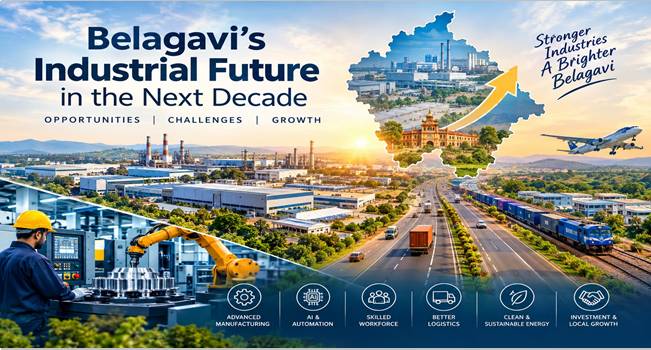
Belagavi’s Industrial Future in the Next Decade: Opportunities and Challenges
By M.K.Hegde
Belagavi is not merely a border district or a historic city. It has carved out a distinct position for itself on Karnataka’s industrial map as an important industrial centre. For decades, entrepreneurs in Belagavi have demonstrated their capabilities in engineering, foundry, machine tools, automobile components, agro-based industries and several other sectors.
However, the next ten years will not be like the previous decade. Changes in global supply chains, the technology revolution, artificial intelligence (AI), automation, demand for skilled manpower, energy costs and faster logistics will increasingly determine the competitiveness of industries.
Against this backdrop, Belagavi faces a crucial question: Should it remain merely an industrial city, or should it transform itself into a new-generation industrial hub over the next decade?
Infrastructure Must Be the First Priority
Infrastructure is the foundation of any industrial growth. Industrial areas must continuously improve basic facilities such as good roads, drainage systems, water supply, waste management, street lighting, fire safety and digital connectivity.
It is not enough merely to establish industrial areas. They must also be maintained and developed to globally competitive standards.
When investors choose a location for setting up a factory, they do not look only at the price of land. The quality of infrastructure, speed of approvals, availability of electricity, transportation facilities and availability of manpower are all critical factors.
Skilled Manpower: The Next Major Challenge
Skilled manpower is as important as land and capital for industrial expansion.
Belagavi has a strong base of educational and technical institutions. However, there is a need to further increase the availability of industry-ready skilled manpower.
New-generation skills in areas such as CNC machining, robotics, automation, precision engineering, electrical systems, industrial software, data analytics and AI-assisted manufacturing need to be developed.
The link between industries and educational institutions must become much stronger. The gap between the skills taught in colleges and the skills required on the factory floor must be reduced.
Logistics and Connectivity: A Decisive Competitive Factor
Industrial production costs are determined not merely by machinery or labour costs. The time taken for raw materials to reach factories, the speed at which finished products reach markets and transportation costs are equally important.
Belagavi’s geographical location offers a major advantage in this regard. With strong connections to important industrial regions of Karnataka, Maharashtra and Goa, Belagavi must further strengthen its road, rail and air connectivity.
A faster and more cost-effective logistics system can provide Belagavi’s industries with a direct competitive advantage.
Expansion of air connectivity, improved rail freight capacity, better national highway connectivity and efficient last-mile connectivity to industrial areas should be among the priorities for the next decade.
Power Cost: The Silent Challenge for Industry
Electricity costs play a major role in determining industrial competitiveness. For energy-intensive manufacturing sectors in particular, even a small change in power tariffs can have a significant impact on production costs.
Along with reliable and quality power supply, industries should be encouraged to adopt renewable energy.
Solar power, captive power generation, energy-efficient machinery and smart energy management can help industries reduce costs over the long term.
Land Availability: Expansion Needs Space
Many existing industries in Belagavi are already at the expansion stage. However, expansion requires suitable industrial land, infrastructure and clear regulatory frameworks.
While land must be made available for new industries, existing industries should also be able to access land and obtain expansion approvals without unnecessary delays.
Existing industries are also investments. Their expansion must receive as much attention as attracting new investments.
Labour Issues: Balancing Industry and Workers
Workers are an integral part of industrial growth. Fair wages, a safe working environment, social security and good workplace conditions are essential for employees.
At the same time, industries must remain competitive through higher productivity, discipline and continuous skill development.
Therefore, industrial relations in the coming decade must move from a conflict-oriented approach towards a model based on partnership, productivity and mutual growth.
AI and Automation: Not a Threat, but an Opportunity
Artificial intelligence and automation are transforming the nature of the industrial world.
The nature of some traditional jobs may change. At the same time, new types of employment and demand for new skills will emerge.
Belagavi’s industries should not view automation as a technology meant only for large companies. It is time for MSMEs to adopt automation gradually and strategically.
Technologies such as predictive maintenance, automated quality inspection, inventory management, production planning, robotics and AI-based decision support can significantly improve productivity and quality.
Most importantly, automation is not simply about purchasing machines.
Human skills + Technology = Future Industrial Capability.
A Strategy to Attract New Investments to Belagavi
The existing industrial ecosystem itself is one of Belagavi’s biggest attractions for new investors. But this strength needs to be systematically presented to the outside world.
A sector-specific strategy can be developed to attract investments in areas such as automobiles and auto components, aerospace, precision engineering, defence manufacturing, renewable energy equipment, food processing, electronics and emerging technologies.
Instead of focusing only on bringing one large company to Belagavi, greater emphasis should be placed on building a supplier ecosystem around major industries.
When a large industry enters a region, it can create opportunities for hundreds of small and medium enterprises. Therefore, along with anchor industries, vendor development and local supply-chain development must receive equal attention.
Existing Industries: The Biggest Opportunity for Growth
Along with efforts to attract new industries, special incentives should be provided for the expansion of industries already operating in Belagavi.
If local entrepreneurs receive easier approvals, better infrastructure, access to finance, technology and skilled manpower, they can expand their businesses and create thousands of additional employment opportunities.
Belagavi’s industrial future will not be built only through investments coming from outside. The next generation of investments by local entrepreneurs will also play a major role.
A Clear Vision for the Next Decade
To transform Belagavi into a major manufacturing and engineering hub over the next ten years, the government, industrial associations, educational institutions and entrepreneurs must work together.
The following clear objectives can be considered:
Upgrade infrastructure in industrial areas to world-class standards.
Create an industry-ready skilled workforce.
Strengthen road, rail, air and logistics connectivity.
Ensure competitive electricity costs and reliable power supply for industries.
Increase the availability of industrial land.
Create a fast-track approval system for expansion of existing industries.
Help MSMEs adopt AI, automation and digital technologies.
Attract new investments through sector-specific strategies.
Establish a continuous industry–academia skill development ecosystem.
Strengthen local supplier and vendor networks.
Finally…
Belagavi does not lack industrial potential. Nor does it lack entrepreneurship.
What is needed is a forward-looking industrial policy and coordinated strategy that can convert existing challenges into opportunities.
The next decade will be decisive for Belagavi.
It should not merely be a decade of establishing new industries. It should be a decade of expanding existing industries, adopting new technologies, developing a skilled workforce, strengthening logistics and connecting Belagavi more firmly with global markets.
The entrepreneurs of Belagavi have already demonstrated their capabilities. The next step is to create the right ecosystem for them to grow.
Over the next ten years, Belagavi has the potential to become more than just an industrial city. It can emerge as a major engine of industrial growth for North Karnataka.
The opportunity is before us. Turning that opportunity into reality is now a collective responsibility.
ಪ್ರಗತಿವಾಹಿನಿ ಸುದ್ದಿಗಳನ್ನು ನಿಮ್ಮ ಸ್ನೇಹಿತರಿಗೆ, ಬೇರೆ ಗ್ರುಪ್ ಗಳಿಗೆ ಶೇರ್ ಮಾಡಿ